Oct 082010
 
Share

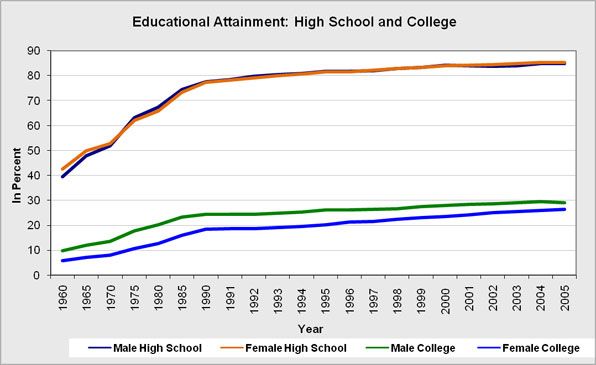
The National Center for Education Statistics made the following points about U.S. education:

  • The percentage of high school graduates that had completed advanced science coursework (i.e., at least one course classified as more challenging than general biology) increased from 35% in 1982 to 68% in 2004
  • “The percentage of high school graduates who had completed courses in advanced mathematics (i.e., completed at least one course classified as more challenging than algebra II) increased from 26 percent in 1982 to 50 percent in 2004.”
  • “The average reading scores at ages 9 and 13 were higher in 2004 than in 1971. The average score for 17-year-olds in 2004 was similar to that in 1971.”
  • Between the school years of 1995-96 and 2005-06, “mathematics SAT scores increased by 10 points, while critical reading scores decreased by 2 points.”
  • “Current expenditures for public elementary and secondary schools will be about $519 billion for the 2008-09 school year. The national average current expenditure per student is around $10,418, up from $9,154 in 2005-06.”
  • “Status dropout rates are reported for 16- through 24-year-olds. The status dropout rate for this age group declined from 15 percent in 1972 to 9 percent in 2006. A decline was also seen between 2000 and 2006, the more recent years of this time span (11 to 9 percent).”
  • “U.S. students scored lower in science literacy than their peers in 16 of the other 29 OECD jurisdictions and 6 of the 27 non-OECD jurisdictions.”
  • “In 2006, the average U.S. score in mathematics literacy was 474 on a scale from 0 to 1,000, lower than the OECD average score of 498”
  • “Among public high school students in the class of 2004-05, the averaged freshman graduation rate was 74.7 percent”

To read additional information, click on National Center for Education Statistics.

Oct 072010
 
Share

PLA had an article on economic growth:

  • GDP stands for Gross Domestic Product and is the measure for economic production. The higher the GDP, the higher the economic production.
  • For the twenty years for which Republican presidents submitted budgets, the average rate of GDP growth was 2.94%.
  • For the twenty years in which Democratic presidents submitted budgets, the average rate of GDP growth was 3.92%.

To read the entire article, click on Just for the Record Part III.

Oct 072010
 
Share

Kelsey Golden in September of 2008 posted an article on ScoopThis.org illustrating relationships between state unemployment rates, controlling political party, and state income taxes.

  • 40% of the states with the unemployment rate higher than the national average are controlled by Republicans”
  • 60% of the states with the unemployment rate higher than the national average are controlled by Democrats.
  • States with a higher-than-national-average unemployment rate have an average state income tax rate of 5.345%
  • “Republicans definitively control 70% of the 10 states with the lowest unemployment rates”
  • Democrats definitively control 20% of the 10 states with the lowest unemployment rates
  • The remaining 10%, Oklahoma, is not controlled by one particular party
  • The average state income tax in the 10 states with the lowest unemployment rates is 5.023%
  • The top 5 lowest unemployment rate states have a state income tax 3.46% compared to the average of 6.08% for the 5 states with the highest unemployment rates.

To read the entire article, click on High Unemployment Rates Tied to Democrat Controlled States and Higher State Taxes; States with Lower Rates Controlled by Republicans with Lower State Taxes.

Oct 072010
 
Share

Dan Ackman on Forbes.com did an analysis comparing Democratic presidents and Republican presidents.

  • Employment gains per year from 1953-2001 were 1.684 million/year under Democratic presidents and 1.279 million/year under Republican presidents.
  • Real Disposable Personal Income Growth per year from 1953-2001 was 3.65% under Democratic presidents and 3.08% under Republican presidents.

To read the entire article click on Presidents And Prosperity.

Oct 072010
 
Share

Laura Rowley on Yahoo Finance asked “what’s at the heart of the U.S. savings problem?” According to Ron Wilcox, professor at the Darden School of Business at the University of Virginia, the answer is “the widening gap between rich and poor. The concentration of income among the wealthiest 1 percent of Americans has roughly doubled in the last 30 years. In 2004, for example, the wealthiest 1 percent of Americans enjoyed a 12.5 percent increase in income, while the bottom 99 percent gained only 1.5 percent.”

To read the entire article, click on Double Bind: Savers on the Hook for Squanderers.

Oct 072010
 
Share

The Center for American Progress in April 2007 reported the following statistics on poverty in the U.S.A.:

  • Persistent childhood poverty costs the U.S. an estimated $500 billion annually
  • Poverty for a family of four is defined as annual family income below $19,971
  • 12.6% of all Americans were below the above threshold in in 2005
  • 31% of all Americans, meaning more than 90 million people, “had incomes below 200 percent of federal poverty thresholds”
  • “One third of all Americans will experience poverty within a 13-year period”
  • In that 13-year time period, “one in 10 Americans are poor for most of the time, and one in 20 are poor for 10 or more years”
  • The U.S. ranks 24 out of 25 countries in terms of the percentage of the population earning 50% below the median income
  • “The richest 1 percent of Americans in 2005 held the largest share of the nation’s income (19 percent) since 1929. At the same time, the poorest 20 percent of Americans held only 3.4 percent of the nation’s income.”

To read the entire report, click on From Poverty to Prosperity: A National Strategy to Cut Poverty in Half.