Oct 092010
 
Share

Alexandre Laurin of the Economics Division of the Canadian Parliamentary Information and Research Service in February 2006 reported the following:

Average Tax Rate on Employment Income, Various Countries, 2004
Single Individuals Without Children with Income of $40,000:
Click on the chart below to see an enlarged, clearer chart.
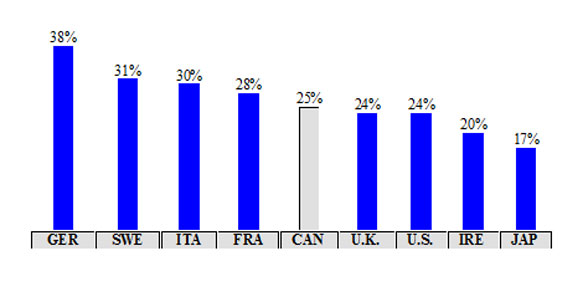
Average Tax Rate on Employment Income, Various Countries, 2004 Single Individuals Without Children with Income of $40,000

Average Tax Rates on Employment Income, Various Countries, 2004
Single Parent with 2 Children and an Income of $40,000:
Click on the chart below to see an enlarged, clearer chart.
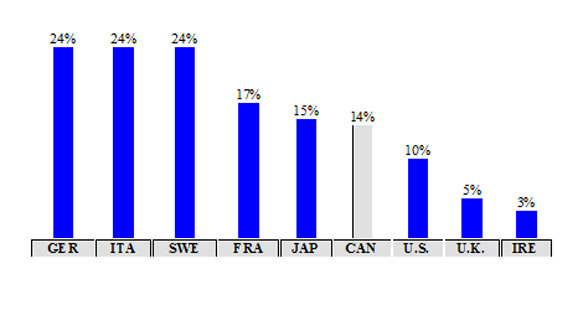
Average Tax Rates on Employment Income, Various Countries, 2004 Single Parent with 2 Children and an Income of $40,000

Average Tax Rate and Marginal Effective Tax Rate
on Employment Income, 2004
Single Individual Without Children with Income of $150,000:
Click on the chart below to see an enlarged, clearer chart.
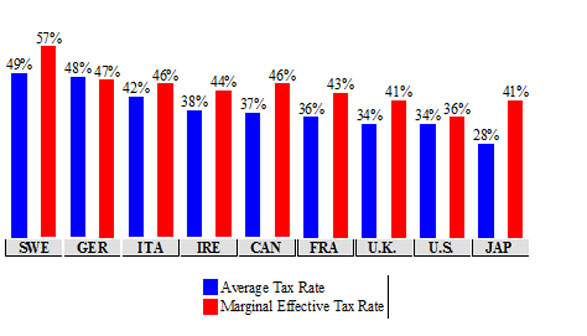
Average Tax Rate and Marginal Effective Tax Rate on Employment Income, 2004 Single Individual Without Children with Income of $150,000

To read the entire report, click on International Tax Burdens: Single Individuals With or Without Children.
Oct 092010
 
Share

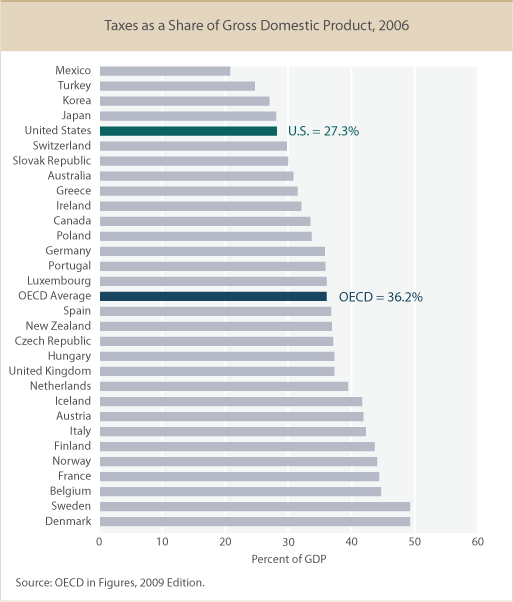
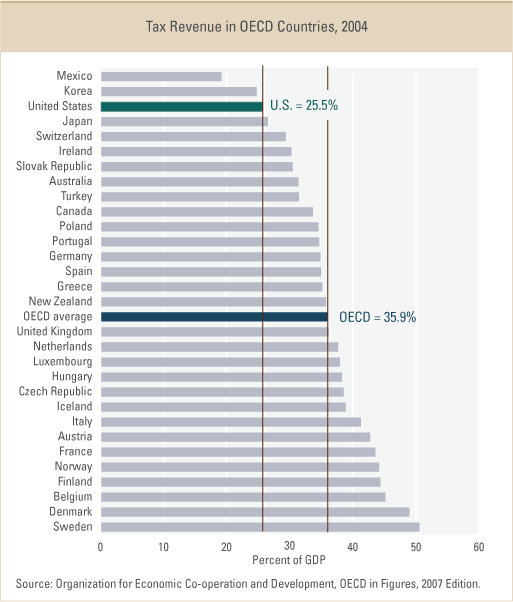
The Tax Policy Center illustrated U.S. taxes at all levels in 2006 and 2004 as a percentage of GDP and compared the U.S. with the remaining 29 member countries of the Organization for Economic Co-operation and Development (OECD). For additional information, click on The Numbers: How do U.S. taxes compare internationally?.

Click on the chart below to see an enlarged, clearer chart.

Tax Rates as a Share of GDP in OECD Countries in 2006

Click on the chart below to see an enlarged, clearer chart.

Tax Rates as a Share of GDP in OECD Countries in 2004

Oct 092010
 
Share

The World Bank and PriceWaterhouseCoopers in 2008 reported on business taxes around the world. The 4 most successful tax reforms:

  • Online filing (25% of the world’s countries have online filing for business taxes)
  • Combine taxes, meaning instead of having a labor/payroll tax, property tax, etc., have one tax
  • Simplify tax administration as countries that do not require special accounting books have 10% more revenue as a percentage of GDP
  • Reduce tax rates and broaden the base

The United States ranked 102 out of 178 countries in Corporate Total Tax Rate ranking with a Corporate Total Tax Rate of 46.2%. The lower the ranking the better.

  • Venuatu ranked #1 with a Corporate Total Tax Rate of 8.4%
  • Saudi Arabia ranked #5 with 14.5%
  • United Kingdom ranked #52 with 35.7%
  • Japan ranked #133 with 52.0%
  • France ranked #157 with 66.3%
  • Gambia ranked #178 with 286.7%

To read the entire report, click on Paying Taxes 2008 The global picture.

Oct 092010
 
Share

Politifact researched health care differences between Switzerland, the Netherlands, and the U.S:

  • Who provides the health insurance: private companies in all three countries
  • “the insurers are indeed private, profit-seeking companies”
  • Who has universal coverage: Switzerland and the Netherlands
  • “As for the number of uninsured Americans, the most commonly cited number is 46 million.”
  • Spending: the Netherlands spent 9.8% percent of gross domestic product, it’s economic output, on health care in 2007; Switzerland spent 10.8%; the U.S. spent 16%

To read the entire article, click on Analyst says Netherlands, Switzerland achieve universal coverage through private insurance.

Oct 092010
 
Share

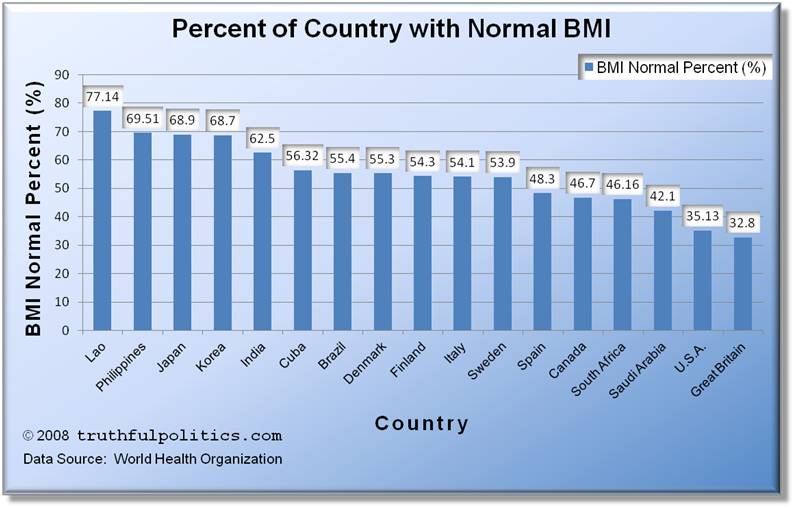
BMI is an index commonly used to classify underweight, normal, overweight, and obese adults. According to the World Health Organization, it is calculated by “weight in kilograms divided by the square of the height in metres (kg/m2). For example, an adult who weighs 70kg and whose height is 1.75m will have a BMI of 22.9.” Normal BMI is within 18.50 – 24.99. A BMI greater than 25 is considered overweight.

The following chart illustrates the percentage of adults in the relative country with a normal BMI. The higher the percentage the better. The World Health Organization has the following warning about the data: “The national BMI data displayed in this graphs are empirical and have been verified that they apply internationally recommended BMI cut-off points. However, it is important to note that the data presented are not directly comparable since they vary in terms of sampling procedures, age ranges and the year(s) of data collection.”

Click on the chart below to see an enlarged, clearer chart.

Percent of Country with Normal BMI

Oct 092010
 
Share

The U.S ranks #46 out of 223 countries, according to the CIA, in longest lifespan. The lower the ranking number the better. Other countries in the rankings:

  • Macau #1 (the longest life expectancy)
  • Japan #3
  • France #9
  • Lebanon #101
  • Vietnam #127
  • Cambodia #176
  • Swaziland #223 (the shortest life expectancy)

To read the entire article, click on Country Comparison :: Life Expectancy at Birth.

Oct 092010
 
Share

The U.S ranks #181 out of 222 countries, according to the CIA, in lowest infant mortality. The higher the ranking number the better. Other countries in the rankings:

  • Singapore #222 (the lowest infant mortality)
  • France #216
  • United Kingdom #193
  • Canada #190
  • Saudi Arabia #144
  • South Africa #59
  • Angola #1 (the highest infant mortality)

To read the entire article, click on Country Comparison :: Infant Mortality Rate.

Oct 092010
 
Share

The World Health Organization said the following:

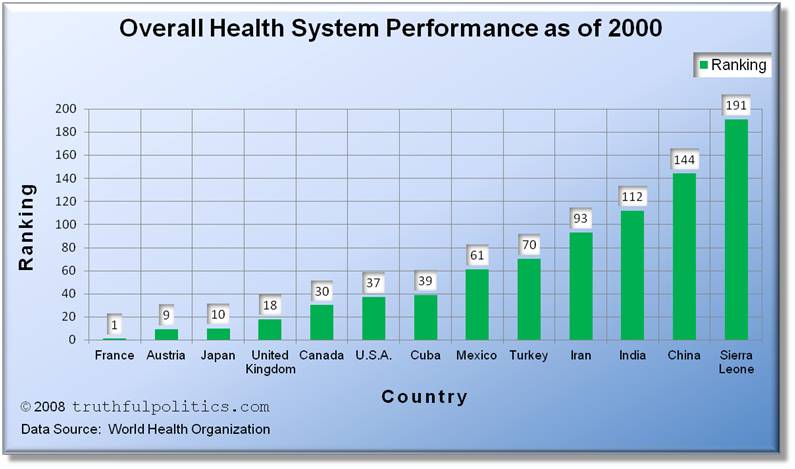
“The U.S. health system spends a higher portion of its gross domestic product than any other country but ranks 37 out of 191 countries according to its performance, the report finds. The United Kingdom, which spends just six percent of GDP on health services, ranks 18 th . Several small countries San Marino, Andorra, Malta and Singapore are rated close behind second- placed Italy.”

Click on the chart below to see an enlarged, clearer chart.

Overall Health System Performance and Ranking by Country

To read the entire press release from 2000, click on World Health Organization Assesses the World’s Health Systems.