Oct 082010
 
Share

The Joint Economic Committee Study done by the United States Congress in 1998 illustrated the impact of federal government size on the economy.

  • The following chart shows 10-year growth rates in the economy since 1799.
  • The average growth rate of the economy for any 10-year period since 1799 is 49.12%.
  • Therefore, the growth rate of the economy has been decreasing for the past 200 years.
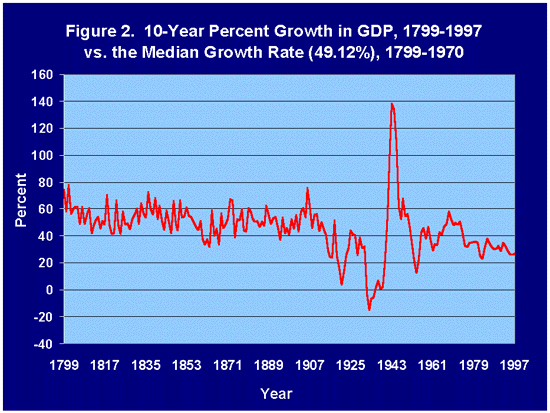
Growth in the U.S. Economy Since 1799

  • “The output slowdown is not unique to the United States. Growth rates in Europe, for example, are lower in the past generation than in the preceding one. Both Europe and the United States have had a marked growth in the size of government relative to total output in recent years.”
  • “By contrast, growth rates in many nations of Asia today are higher than a generation ago. In many of these places, such as Hong Kong or Korea, the private sector’s growth has been faster than that of government. That is particularly true in the region’s giants, China and India. As government’s role in resource allocation has declined relative to that of the market-based private economy, it seems that growth rates have accelerated.”
  • For each 1 percent increase in the government share of the economy (GDP), the GDP itself falls by about $30 billion (in 1992 dollars)
  • “The data here suggest that a further reduction in government size to 17.45 percent of GDP would be growth enhancing.”
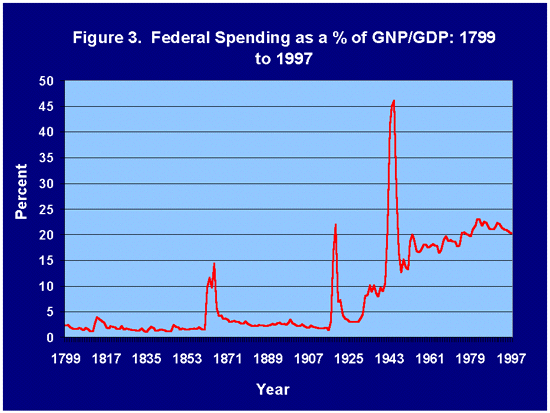
Federal Spending as a Percentage of GDP

  • Transfer payment programs (incorporating income security, health, medicare, and social security) reached their optimal size from an output maximization perspective at about 7.33 percent of GDP, about the level reached in 1974
  • “There is no statistically significant relationship between spending on health and [economic] output.”
  • The findings seem to contradict the idea that “‘imperial reach’ may be contributing to U.S. economic decline.”
  • The only category of federal spending, which shows some positive relationship with [economic] output, is the category that includes such things as educational, highway, environmental, agricultural, and foreign aid spending.

Conclusions for the size of federal government to increase economic output:

  • “reduce federal expenditure growth in general below that of total output growth, thereby reducing the claim that federal spending makes on total output;
  • place particular emphasis on containing transfer payments, stopping their growth relative to income and output. These results support the arguments of persons advocating limiting the growth of entitlements.
  • the maintenance of balanced budgets would appear to be useful, inasmuch as that would reduce net interest payments of the federal government as a percent of GDP over time.”

To read additional information on state and local governments and whether they should downsize, click on Should the U.S. State and Local Governments Downsize to Increase Economic Output? (and Additional Information on the Armey Curve). To read the entire Joint Economic Committee Study, click on Government Size and Economic Growth.
Oct 082010
 
Share

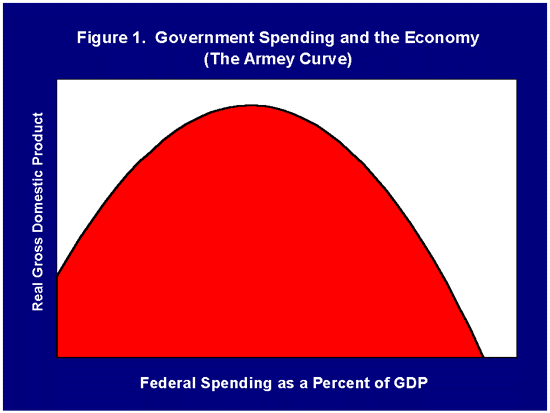
The Armey Curve was developed by United States Representative Richard Armey. The term describes the concept that in anarchy [when there exists no government], the economic output of a country is low, and in a country where all decisions are made by government, economic output of the country is low. Therefore, a mix of private and government decisions maximizes economic growth.

Government Spending and the Economy (The Armey Curve)

To read additional information, click on the Joint Economic Committee Study done by the United States Congress in 1998 called Government Size and Economic Growth. Additional information on the Armey Curve may be read in truthful politics by clicking on Should the U.S. Federal Government Downsize to Increase Economic Output? (and Additional Information on the Armey Curve).

Oct 082010
 
Share

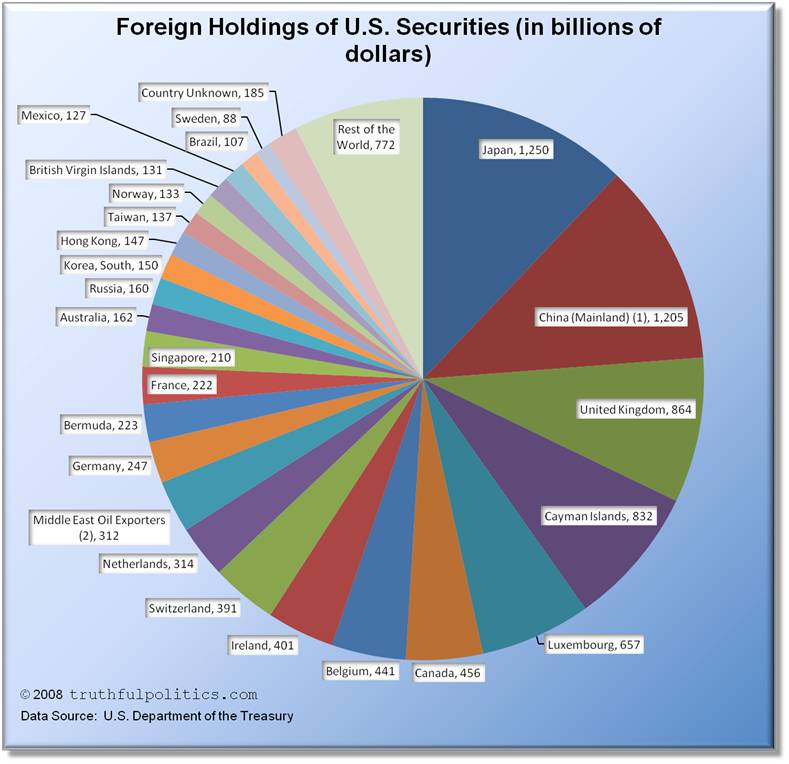
Truthfulpolitics.com reviewed the Preliminary Report on Foreign Holdings of U.S. Securities at End-June 2008 from the U.S. Treasury Department issued in February 2009.  The report shows what countries hold United States debt and the amount.

  1. China (Mainland) excludes Hong Kong, Macau, and Taiwan, which are reported separately.
  2. Middle East Oil Exporters includes Bahrain, Iran, Iraq, Kuwait, Oman, Qatar, Saudi Arabia, United Arab Emirates.

Click on the chart below to see an enlarged, clearer chart.

Foreign Holdings of U.S. Securities/Debt

To read the entire report, click on Preliminary Report on Foreign Holdings of U.S. Securities at End-June 2008.

Oct 082010
 
Share

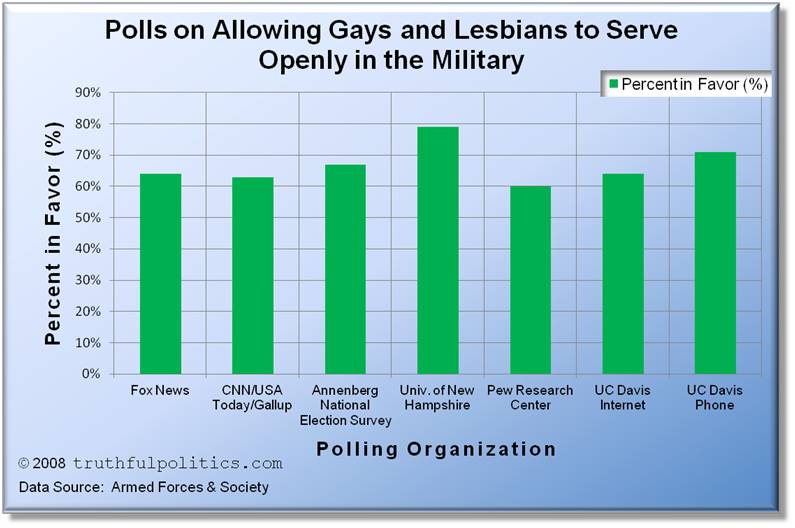
Click on the chart below to see an enlarged, clearer chart.

Polls on Allowing Gays and Lesbians to Serve Openly in the Military

To read additional information, click on Palm Center of the University of California at Santa Barbara, Sage Publications “Don’t Ask, Don’t Tell”, and the respective polling organizations.


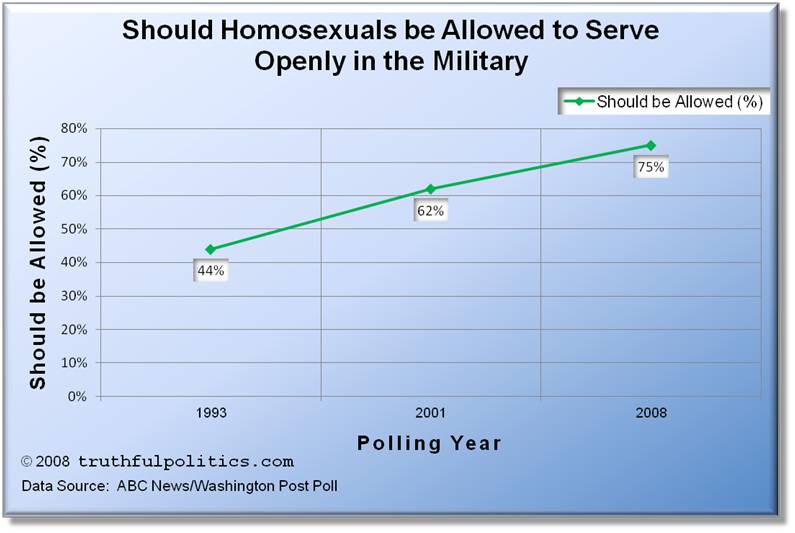
Click on the chart below to see an enlarged, clearer chart.

Polls on Allowing Gays and Lesbians to Serve Openly in the Military 1993-2008

According to the International Lesbian and Gay Association (ILGA), the following countries allow openly gay, lesbian and bisexual persons to serve in the army. The report was published in 2006 and the year next to each country indicates the year that country allowed service:

Australia (1992), Austria, Bahamas, Bulgaria (2004), Canada (1992), Colombia (1999), Croatia, Czech Republic (1999), Denmark (1978), Estonia, Finland, France, Germany (2000/01), Hungary, Ireland, Israel (1993), Italy, Lithuania, Luxembourg, Netherlands (1973), New Zealand (1993), Norway (1979), Peru (2004), Portugal (1999), Slovenia, South Africa (1996), Spain, Sweden (1976), Switzerland (1992), Taiwan (2002), Thailand (2005), United Kingdom (2000).

The following countries do not allow open service:

Argentina, Belarus, Brazil, Cyprus, Greece, Libya, Philippines, Russia, Serbia, Singapore, South Korea, Turkey, United States.

To read the entire report, click on LGBT world legal wrap up survey.

Oct 082010
 
Share

According to the United States General Accounting Office, in 1997 there were 1,049 federal laws in which benefits, rights, and privileges based on marital status. In 2003, 1,138 federal laws existed. The benefits included social security benefits, veterans’ benefits, taxation, federal employee benefits, immigration and naturalization, and intellectual property rights. To read the entire report, click on Defense of Marriage Act: Update to Prior Report.

Oct 082010
 
Share

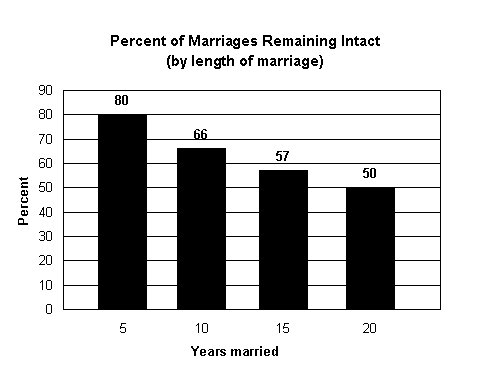
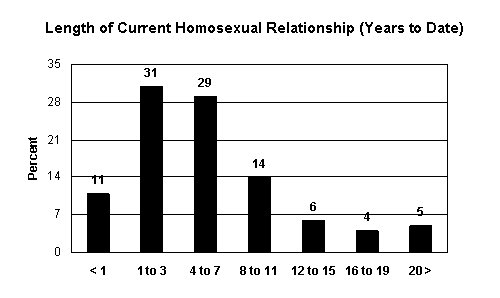
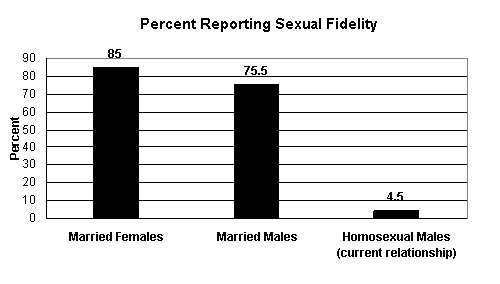
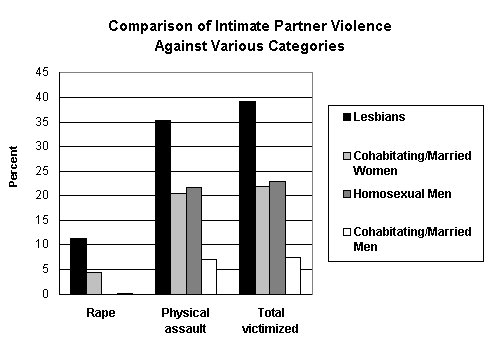
The Family Research Council illustrated some differences between homosexual couples and heterosexual couples.

  • Heterosexual marriages last longer the homosexual relationships.
  • Percent of Heterosexual Marriages Remaining Intact
    Length of Current Homosexual Relationship

  • Homosexual males have more infidelity than heterosexual couples.
  • Percent Reporting Sexual Fidelity

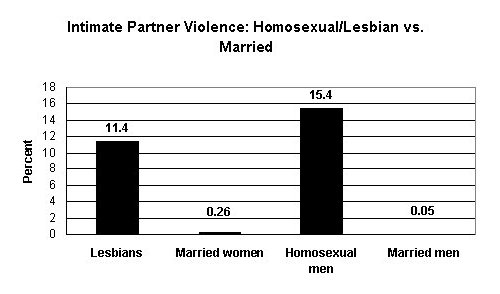
  • Violence between the partners happens more in homosexual relationships than in heterosexual relationships.
  • Comparison of Intimate Partner Violence
    Intimate Partner Violence Between Homosexuals and Heterosexuals

To read the entire article, click on Comparing the Lifestyles of Homosexual Couples to Married Couples. To read information on benefits availability between same-sex couples and heterosexual couples, click on Benefits Available to Same-Sex Couples Compared to Heterosexual Couples.

Oct 082010
 
Share

According to Michael Dobbs of The Washington Post “domestic partnerships or civil unions were introduced in Washington D.C. in 1992, Hawaii in 1997, Vermont and California in 2000, Maine in 2004, Connecticut in 2005, and New Jersey in 2006, and Washington in 2007. Only one state, Massachusetts (2004), permits same-sex marriage.” Marriage rates have decreased from 69.3% in 1960 to 56.3% in 2006. Marriage rates “have not fallen appreciably faster in the last decade than during the preceding four decades.”

To read the entire article, click on Sam Brownback and Gay Marriage.

Oct 082010
 
Share

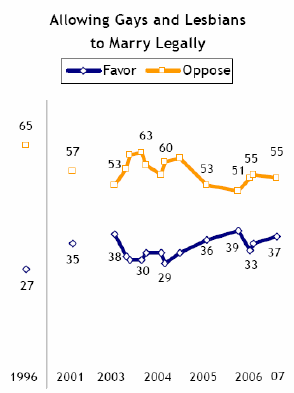
According to the Pew Research Center, “a study released by the European Commission in 2006 found that a plurality of people in the European Union (49%) oppose gay marriage. Yet, as in the United States, the public remains divided, with 44% [of people in the European Union] favoring same-sex marriage.”

The article also stated “that while a majority of Americans (55%) oppose same-sex marriage, a sizable minority (37%) favor it, figures that have varied only slightly since 2001. A 2006 Pew survey also found that a majority of Americans (54%) favor allowing civil unions, up from 45% in 2003.”

Percentage that Favor or Oppose Gays and Lesbians to Marry Legally

Source: Pew Research Center, Trends in Political Values and Core Attitudes: 1987-2007, March 22, 2007

To read the entire article, click on Same-Sex Marriage: Redefining Marriage Around the World.