Oct 082010
 
Share

Dr. Sara R. Collins in November of 2007 mentioned the following in her testimony to the U.S. House of Representatives:

  • “With their high premiums and underwriting, individual insurance plans which cover just 6 percent of the under-65 population have proven to be an inadequate substitute for employer group coverage.”
  • “More than two-thirds (67%) of adults under age 65 who do not have health insurance are in families where at least one member works full time.”
  • “In 2005, 53 percent of people with incomes less than $20,000, and 41 percent of people in households with incomes between $20,000 and $40,000, reported a time when they were uninsured in the prior year.”
  • “More than 13 million young adults ages 19 to 29 are uninsured, the fastest growing age group among the uninsured population.”
  • “Sixty-two percent of working-age Hispanics and 33 percent of African Americans were uninsured for some time during 2005, compared with 20 percent of whites in the same age group.”
  • “Medical debt forces families to make stark tradeoffs. For example, 40 percent of uninsured adults with medical bill problems were unable to pay for basic necessities like food, heat, or rent, and nearly 50 percent had used all their savings to pay their bills.”
  • “The Institute of Medicine estimates that 18,000 avoidable deaths occur each year in the U.S. as a direct result of individuals being uninsured”
  • “people without health insurance collectively lose between $65 billion and $130 billion a year in lost productivity and earnings”

To read the entire testimony, click on Congressional Testimony–Widening Gaps in Health Insurance Coverage in the United States: The Need for Universal Coverage. To see how the U.S. Health Care System ranks against other countries, click on U.S. Health Care Ranking Compared to Other Countries.
Oct 082010
 
Share

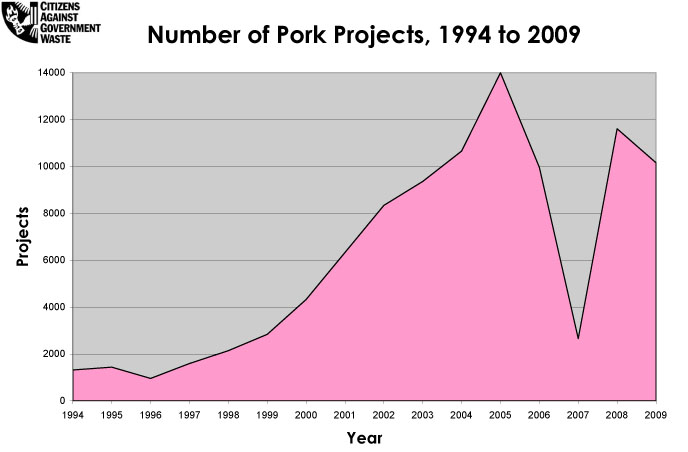
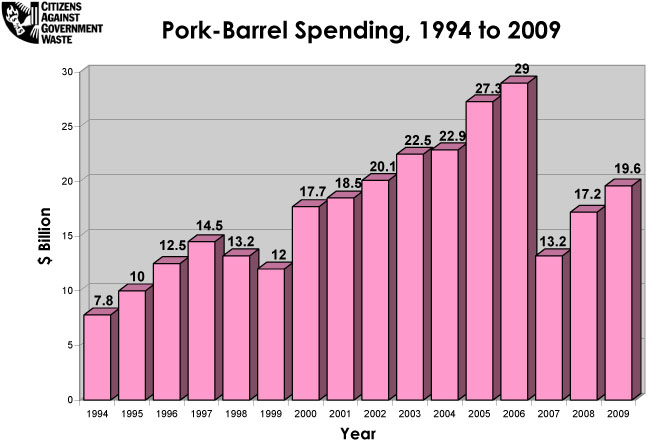
According to Citizens Against Government Waste, a “‘pork’ project is a line-item in an appropriations bill that designates tax dollars for a specific purpose in circumvention of established budgetary procedures.” US Legal defines pork spending, or pork-barrel legislation, as “appropriations of public funds by Congress or other legislative bodies for pet projects that serve the interests local districts these legislators represent, rather than the interests of the larger population.”

Click on the chart below to see an enlarged, clearer chart.

Number of Pork Projects 1994-2009

Click on the chart below to see an enlarged, clearer chart.

Pork-Barrel Spending 1994-2009

To read more, click on Citizens Against Government Waste.

Oct 082010
 
Share

Truthfulpolitics.com reviewed the U.S. Department of Defense Base Structure Report of 2008:

  • The Department of Defense has 545,700 facilities located on more than 5,400 sites on 30 million acres
  • At least 1 base in all 50 states
  • 761 bases in 39 foreign countries, including 268 bases in Germany, 124 in Japan, and 87 in South Korea
  • Value of the bases equals $706,000,000,000, or $706 billion

To read the entire report, click on Department of Defense Base Structure Report Fiscal Year 2008 Baseline or click on U.S. Department of Defense Publications. For additional information on U.S. Military spending, click on U.S. Military Spending Compared to Other Countries.
Oct 082010
 
Share

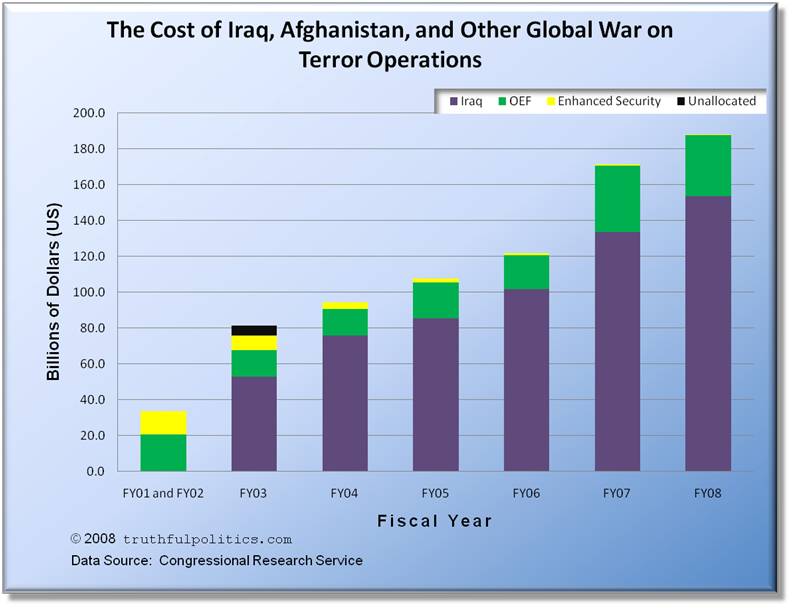
The Congressional Research Service in October of 2008 provided a report for congress on the expenditures on the War on Terror:

  • “Operation Enduring Freedom (OEF) covering Afghanistan and other Global War on Terror (GWOT) operations ranging from the Philippines to Djibouti that began immediately after the 9/11 attacks and continues”
  • Enhanced Security is for “Operation Noble Eagle (ONE) providing enhanced security for U.S. military bases and other homeland security that was launched in response to the attacks and continues at a modest level”
  • Iraq is for “Operation Iraqi Freedom (OIF) that began in the fall of 2002 with the buildup of troops for the March 2003 invasion of Iraq and continues with counter-insurgency and stability operations”
  • FY01 is 2001, FY02 is 2002, etc.

Click on the chart below to see an enlarged, clearer chart.


The Cost of Iraq, Afghanistan, and Other Global War on Terror Operations

To read the entire report, click on The Cost of Iraq, Afghanistan, and Other Global War on Terror Operations Since 9/11.

Oct 082010
 
Share

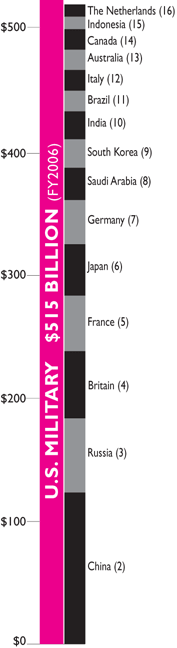
U.S. Military Spending Compared to Other Countries

The numbers in parentheses next to country names indicates the amount of those respective countries’ military spending in billions of U.S. dollars. For example, The Netherlands (16) means The Netherlands spends $16 billions dollars in military spending.

The chart on the left is from the War Resisters League website. Additional information can be accessed on U.S. Military Spending vs. The World.


The SIPRI Yearbook 2007: Armaments, Disarmament and International Security stated the following:

“World military expenditure continued to increase during 2006. This upward trend is attributable primarily to the USA, which accounted for 62 per cent of the total increase in world military expenditure and 46 per cent of total world
military spending in 2006.” It continued, “In Europe total military expenditure has been relatively stable in recent years. In both East Asia and the Middle East, increasing financial resources has been decisive in driving military expenditure upwards. China is the prime example of a country where a booming economy, amongst other factors, has allowed a steep rise in military expenditure. In both South America and Eastern Europe, military expenditure has been increasing partly because of modernization and re-equipment of the armed forces.”

To read the entire yearbook, click on Armaments, Disarmament and International Security.

Oct 082010
 
Share

In article 1, section 8 of the Constitution, it reads that the Congress shall have power:

  • To declare War
  • To raise and support Armies, but no Appropriation of Money to that Use shall be for a longer Term than two Years

To read the entire Constitution, click on The Constitution of the United States: A Transcription.

According to the United States Department of Justice in September 2001, in the history of the U.S., on 125 occasions, the President initiated military action without prior express authorization from Congress. To read the entire memorandum opinion, click on THE PRESIDENT’S CONSTITUTIONAL AUTHORITY TO CONDUCT MILITARY OPERATIONS AGAINST TERRORISTS AND NATIONS SUPPORTING THEM.

Oct 082010
 
Share

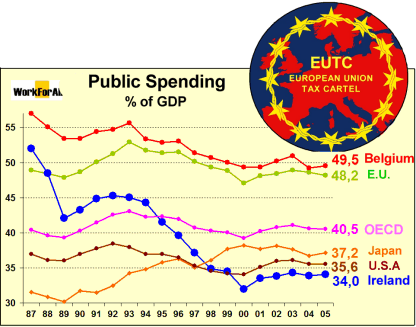
WorkforAll had the following illustration with U.S. federal government spending compared to other countries.

  • GDP stands for Gross Domestic Product and is a measure of the economy as it measures the total market value of all final goods and services produced in a country in a given year.
  • E.U. stands for European Union which is an economic and political partnership between 27 European countries.
  • OECD stands for Organisation for Economic Co-operation and Development and the OECD percentage is the average of the 34 member OECD countries.
  • Commas are used for the decimal mark, which is a common convention in Europe and South America.  For example, the 35,6 means 35.6%.

illustration of U.S. Federal Government Spending as a Percentage to the U.S. Economy Compared to Other Countries

To read the entire article, click on EU : Causes of Growth differentials in Europe.

Oct 082010
 
Share

The Perot Charts website had a graph of the growth of the U.S. economy:

Click on the chart below to see an enlarged, clearer chart.

U.S. Gross Domestic Product from 1945 to 2007

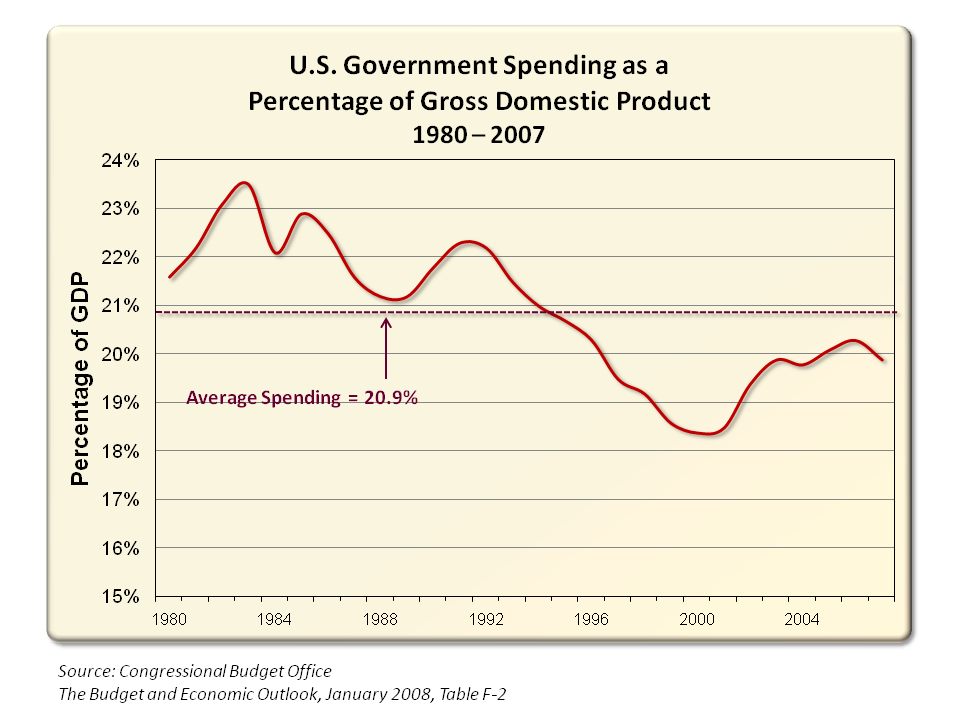
Therefore, when U.S. government spending is based as a percentage to the U.S. economy, the following trend develops:

Click on the chart below to see an enlarged, clearer chart.

U.S. Government Spending as a Percentage of Gross Domestic Product from 1980 to 2007

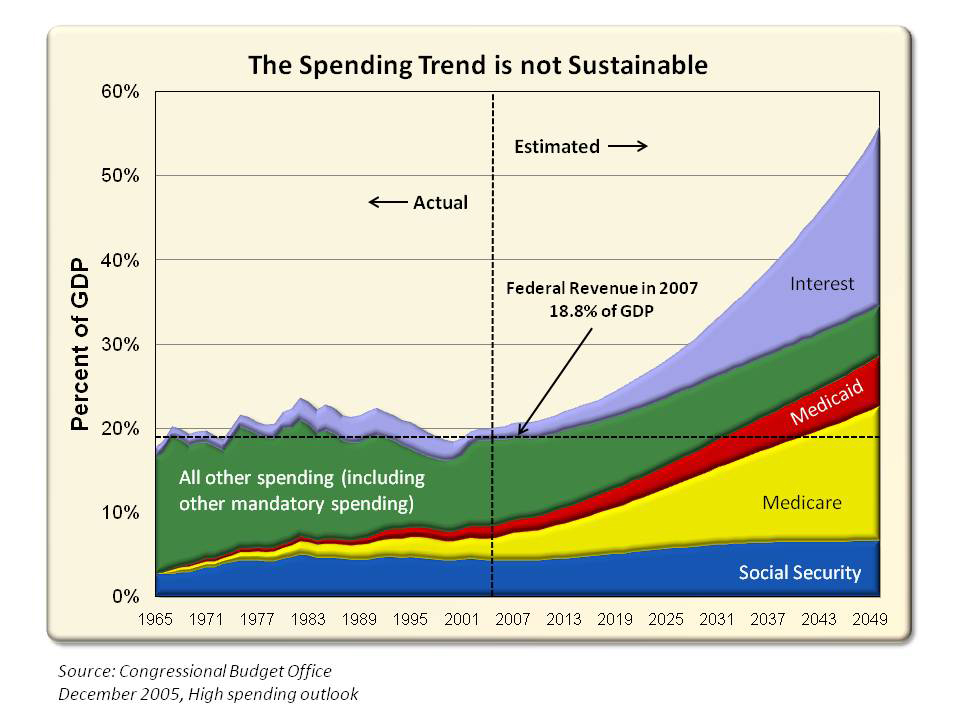
A projection of what the spending will look like in the future:

Click on the chart below to see an enlarged, clearer chart.

U.S. Government Spending Projection

To view additional information and charts, click on U.S. Government Spending as a Percentage of Gross Domestic Product 1980 – 2007.


Patrick Henry had the following graph:

Click on the chart below to see an enlarged, clearer chart.

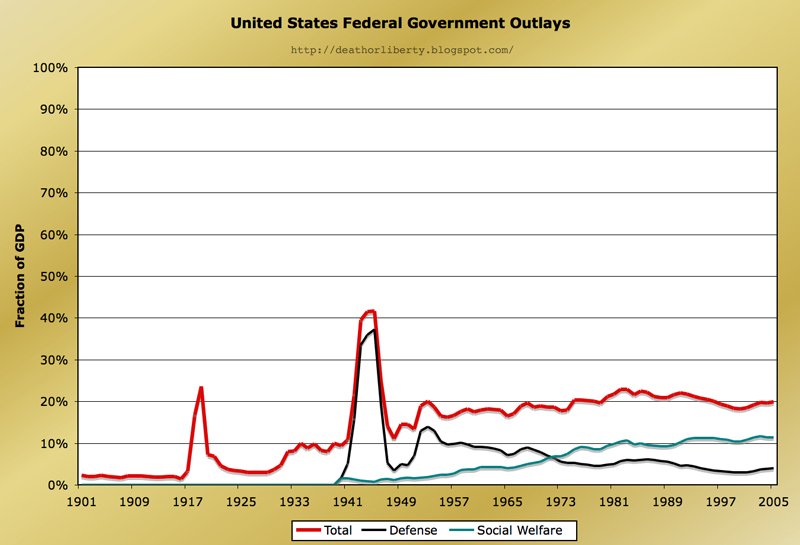
U.S. Federal Government Outlays as a Percentage to the U.S. Economy, including total spending, defense spending, and social welfare spending

To read the entire article, click on government spending is NOT out of control.

Oct 082010
 
Share
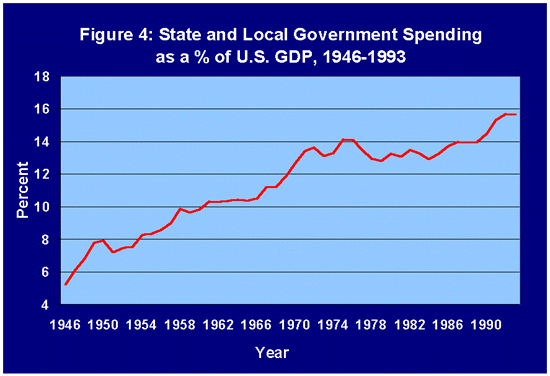
  • “The size of state and local government that maximizes the growth rate in GDP is 11.42 percent.”
  • “In 1993, state and local spending was 15.68 percent of GDP”

State and Local Government Spending as a Percentage of U.S. GDP

To read additional information on the federal government and whether it should downsize, click on Should the U.S. Federal Government Downsize to Increase Economic Output? (and Additional Information on the Armey Curve). To read the entire Joint Economic Committee Study, click on Government Size and Economic Growth.