Nov 012010
 
Share

Kimberly Leonard and Aaron Mehta of The Center for Public Integrity in October 2010 reported the following:

  • John Raese, Republican, spoke against government spending and spoke for controlling the federal budget. His company Greer Industries Inc. sold $2.7 million of products to the federal government and $29 million to the state of West Virginia.
  • Reid Ribble, Republican, spoke against the American Recovery and Reinvestment Act of 2009, commonly referred to as the stimulus bill. A construction company owned by memebers of his family received $130,000 in stimulus funds.
  • Robin Carnahan, Democrat, “called for a halt to expanded stimulus spending”. Her brother’s company, Wind Capital Group, received $107 million in 2009 from the stimulus.
  • Tom Ganley, Republican, spoke against the “cash for clunkers” program. Ganley’s auto dealership received approximately $3.7 million from the program.
  • Scott Rigell, Republican, spoke against government spending and the stimulus. His auto dealerships received $568,500.

To read the entire article, click on Some Anti-Spending Candidates’ Businesses Have Government Contracts, Tax Breaks In Their Past.
Nov 012010
 
Share

The U.S. military has explored using alternative energy:

  • The U.S. Navy tested a 49 foot gunboat that runs on algae-based fuel and diesel in October 2010.
  • According to an article in The Guardian, a gallon of gas costs $400 whereas a gallon of algae-diesel mix costs $424 per gallon.
  • The military switched to diesel fuel previously.
  • According to an article in The Oakland Press, the U.S. Army pays $16 to $17 per gallon.
  • In forward operating bases in Afghanistan, diesel costs $40 per gallon.
  • “A 1 percent improvement in fuel economy of military vehicles means the number of soldiers required to serve as escorts drops by more than 6,000, or the equivalent of one infantry brigade”.
  • The U.S. military uses between 400,000 barrels of oil a day during peacetime and 800,000 barrels a day during the height of the Iraq War.
  • The U.S. military is the largest single buyer of oil.
  • Every $10 increase in the price of oil costs the U.S. Air Force an additional $600 million each year.

To read additional information, click on US navy completes successful test on boat powered by algae, Military sees big role for hybrid, electric vehicles, or Surging price of oil forces US military to seek alternative energy sources.

Oct 262010
 
Share

David Nather of The Center for Public Integrity in October 2010 reported the following:

  • Medicare expenses grow faster than Social Security expenses.
  • Medicare expenses have grown faster than the economy by 1.3% to 3% over the past 40 years.
  • In 2009, Medicare trustees said Medicare faces $36 trillion in unfunded obligations. However, in 2010 the trustees said the unfunded number has been eliminated with the new health care reform law.
  • In 2010 Medicare spending will be $451 billion, or 12% of all government expenses.
  • “Because of the aging of the population, driven by the large cohort of baby boomers, Medicare is expected to cover as many as 79 million people in 20 years — nearly twice as many as it covers now.”

To read the entire report, click on Medicare: An Entitlement Out of Control.

Oct 252010
 
Share

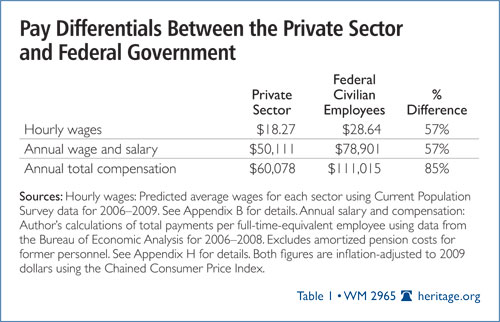
James Sherk of The Heritage Foundation in July 2010 reported the following:

  • Federal employees earn 22% more than their comparable private sector counterparts.
  • “Aligning federal compensation with market rates would save taxpayers approximately $47 billion a year.”
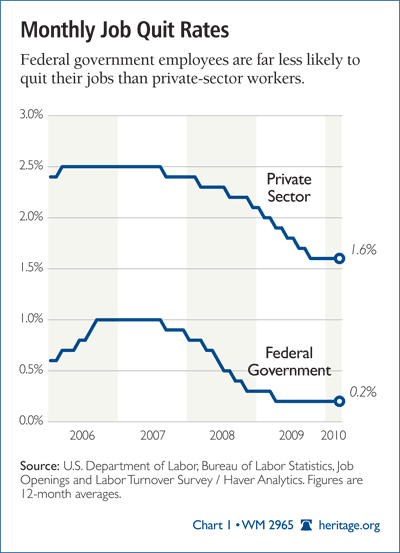
  • Federal employees voluntarily quit 67% less than their comparable private sector counterparts.

Pay Differentials Between the Private Sector and Federal Government

Monthly Job Quit Rates Between the Private Sector and Federal Employees

To read the entire report, click on Comparing Pay in the Federal Government and the Private Sector.


Dennis Cauchon in USAToday in December 2009 reported the following:

  • From December 2007 to June 2009, the U.S. federal government added 192,700 jobs.
  • In December 2007, the Defense Department had 1,868 civilian employees earning $150,000 or more. In June 2009, the number increased to 10,100.
  • The average federal worker earns $71,206 annually, compared to $40,331 in the private sector.
  • In January 2008, President Bush “recommended – and Congress approved – across-the-board raises of 3%” and “3.9% in January 2009. President Obama has recommended 2% pay raises in January 2010, the smallest since 1975.”

To read the entire article, click on For feds, more get 6-figure salaries.

Oct 242010
 
Share

Florida currently does not allow gays to adopt. It is the only state in the United States with such a law. On January 10, 2005, the Supreme Court refused to hear a case to challenge the Floridian law. To read the article in the Washington Post click on Gay-Adoption Ban In Florida to Stand.


Update on the Above Law

According to the American Civil Liberties Union (ACLU) on October 2010, Florida Attorney General Bill McCollum will not appeal the September 22, 2010 ruling from the 3rd District Court of Appeal striking down the above law. Therefore, gay people will be able to adopt moving forward. To read the entire article, click on Florida Attorney General Won’t Challenge Ruling Striking Down Gay Adoption Prohibition.


A joint study between the The Williams Institute of the UCLA School of Law and The Urban Institute mentioned the following:

  • More than 100,000 foster children await adoption
  • More than half of gay men and 41 percent of lesbians want to have a child
  • An estimated 65,500 adopted children are living with a lesbian or gay parent
  • A national ban on GLB foster care could cost foster care systems from $87 to $130 million
  • More than half of same-sex couples have a college degree, “compared to a third of men and women in different-sex married couples, a fifth of single parents, and only 7 percent of those in different-sex unmarried couples”
  • Same-sex couples with adopted children have an average annual household income of $102,474. “Different-sex married couples compare at $81,900 followed by different-sex unmarried couples at $43,746 and single parents (including heterosexual, gay, lesbian, and bisexual people) at $36,312 per year.”

The entire study may be read by clicking on Adoption and Foster Care by Gay and Lesbian Parents in the United States.

Oct 232010
 
Share

The American Recovery and Reinvestment Act in 2009 was a $787 billion dollar package. John Solomon and Aaron Mehta of The Center for Public Integrity in October 2010 reported that “the Center collected a stack of letters a foot high detailing nearly 2,000 requests from lawmakers in both parties to secure funding from a law designed to stimulate the sagging economy. The Center obtained a total of more than 1,500 of these letters from just three departments: Transportation, Energy, and Commerce.” The practice of writing letters for projects is called lettermarking. “Jack Abramoff, since convicted on charges related to fraud and bribery, often arranged for lawmakers to send letters to agencies pressing for appropriation funds, then followed up with donations to the lawmakers who acquiesced.”

John Solomon and Aaron Mehta also reported the following:

  • Representative Pete Sessions, a Republican from Dallas, Texas, called the stimulus wasteful, and then asked Transportation Secretary Ray LaHood for $81 million from the stimulus for a project in the Carrollton suburb, suggesting the project would create jobs.
  • Representative Brad Ellsworth, a Democrat from Indiana, receivedd $6,500 from Duke Energy’s political action committe (PAC). He voted against the stimulus and then later wrote for a grant from the Energy Department for Duke Energy.
  • Senator John McCain, a Republican from Arizona, voted against the stimulus package, and sent a letter to the Department of Transportation for money for the Phoenix Sky Harbor International Airport.
  • Senator Scott Brown, a Republican from Massachusetts, spoke against the stimulus package’s ability to create jobs. He wrote a letter requesting stimulus money for the Massachusetts Broadband Institute (MBI) saying that it would help entrepreneurs and job creators. MBI was awarded $45.4 million.
  • Representative Michele Bachmann, a Republican from Minnesota, “has complained the stimulus bill will require ‘massive tax increases’ to create short-term jobs and ran a campaign ad this month boasting that she fought against ‘the failed Pelosi trillion-dollar stimulus.'” She wrote a letter “the Transportation Department for the St. Croix River Crossing Project that she argued ‘would directly produce 1,407 new jobs per year while indirectly producing 1,563 a year – a total of 2,970 jobs each year after the project’s completion.'”
  • Representative Walt Minnick, a Democrat from Idaho, voted against the stimulus bill, and wrote letters to Commerce Secretary Gary Locke for money for broadband projects.

To read the entire article, click on Stimulating Hypocrisy: Scores of Recovery Act Opponents Sought Money Out of Public View.

Oct 232010
 
Share

Marisol Bello in USAToday in November 2009 reported the following:

  • 49 million Americans went hungry or had insufficient food at some point in 2008.
  • The above number is the highest reported since the government started tracking the statistic in 1995.
  • In the same year, “16.7 million children did not eat regularly at some point”.
  • “Vicki Escarra, president and CEO of Feeding America, the country’s largest hunger-relief organization, said its food banks in states hit hardest by the recession, including Nevada, Florida, Michigan, California and Ohio, have seen 50% increases in people turning to them for help.”
  • According to the United Nations, 1 in 6 of all people on the planet, approximately 1 billion people, do not have enough to eat.

To read the entire article, click on ‘Wake-up call’: 1 in 6 went hungry in America in 2008.

Oct 222010
 
Share

According to the CDC, the Centers for Disease Control and Prevention, part of the Department of Health and Human Services, food “deserts are areas that lack access to affordable fruits, vegetables, whole grains, low-fat milk, and other foods that make up the full range of a healthy diet.” The USDA (United States Department of Agriculture) has a map, or atlas, depicting food choices and demographics of the U.S. by county. To access the map, click on Your Food Environment Atlas.

In addition, the U.S. Department of Agriculture published in 2009 a report on access to affordable and nutritious food:

  • 5.7% of households in the U.S. do not have access to the kinds of foods they wanted
  • Food prices are 10% lower at supermarkets than smaller foodstores
  • Food “eaten at restaurants is less affordable due to its higher per unit cost relative to foodstores and other retail food outlets.”
  • “Median distance for low-income individuals is about 0.1 of a mile less than for those with higher income, and a greater share of low-income individuals (61.8 percent) have high or medium access to supermarkets than those with higher income (56.1 percent).”
  • Ethnic “and racial minorities have better access to supermarkets than Whites.”
  • Out of the entire U.S. population, between 2.3% – 5.5% “of all households may be outside of a walking distance to a supermarket and lack access to a vehicle.”
  • The “percentage of households without access to vehicles is higher in low-income areas. Overall, 0.9 million households do not have access to a vehicle and live in low-income areas more than a mile from a supermarket. This represents 3.6 percent of all households in low-income areas. A much greater percentage of households without vehicles in low-income areas is between one-half to 1 mile from the nearest supermarket—1.6 million households, or 6.4 percent of all low-income households.”

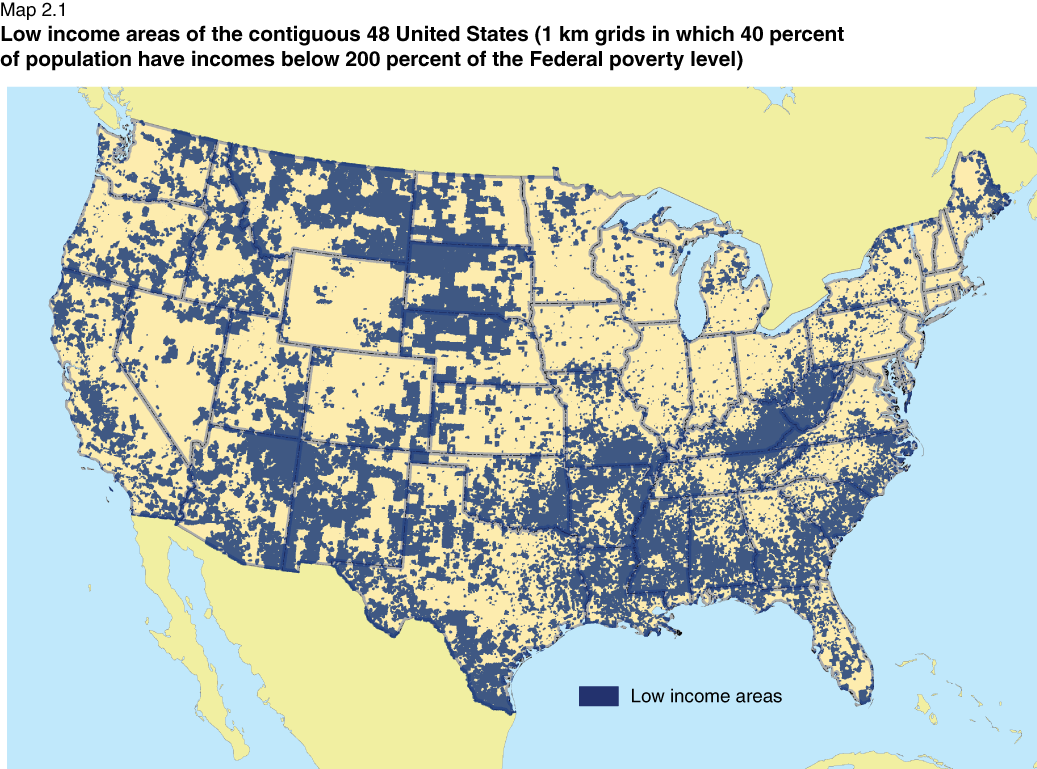
Click on the chart below to see an enlarged, clearer chart.

Low Income Areas of the Contiguous 48 United States

To read the entire report from the USDA, click on Access to Affordable and Nutritious Food—Measuring and Understanding Food Deserts and Their Consequences: Report to Congress. To read additional information on Food Deserts from the CDC, click on Food Deserts.